Woodland Hills Real Estate Market 2026: Two Boundaries That Shape Prices
September 24, 2026
September 24, 2026
If you've been watching Woodland Hills from outside the neighborhood, the story looks simple. A $10 billion development is replacing a dead mall, a football team is building its permanent home there, and prices should follow. The Promenade Mall came down starting in January 2026, and by this summer the site was cleared rubble. That part is real, and it is visible from Topanga Canyon Boulevard.
What is not real yet is the district itself. Rams Village at Warner Center, the Kroenke Organization's 52-acre plan for the old Promenade and the adjacent former Anthem office parcel, remains a proposal under review by the LA City Planning Department. No building permits have been issued for it. No vertical construction has started. The gap between a demolished mall and an entitled district is exactly where a lot of confusion about Woodland Hills pricing is coming from right now, and it's obscuring the two boundaries that are actually doing the work: the grade change at Ventura Boulevard, and the city line into Calabasas.
The sequence is worth laying out plainly, because the order matters more than the headline:
None of that means the project won't happen. It means anyone pricing a house near Warner Center right now is pricing a demolished mall and an unbuilt proposal, and those are two different things to pay for.
What's actually under construction in Warner Center this year has nothing to do with the Rams. Meta Housing and R.D. Olson Construction have completed the first phase of The Alcove, an affordable housing project, and broke ground on the second phase, Nova at The Alcove, targeting a spring 2028 completion. Elysian Housing and Capstone Equities are separately pursuing more than 300 units of income-restricted housing at 21155 Califa Street. Wellpointe is seeking entitlements for a multi-tower project at 6400 Canoga Avenue that could deliver thousands of affordable senior units. All of this is moving under the incentives written into the Warner Center 2035 Specific Plan, the transit-oriented framework the city adopted back in 2013 to spur exactly this kind of infill. If you're looking for cranes that represent approved, funded construction in Warner Center today, they belong to affordable housing, not to the stadium district.
The mall came down before the district got approved. That gap between what's visible and what's entitled is where a lot of the pricing confusion in Woodland Hills lives right now.
The headline number for Woodland Hills, the one you'll see on any portal, was a median sale price around $1.2 million over the three months ending May 2026, down 5.2 percent year over year, at $613 per square foot, with homes selling after 46 days on market. That number is accurate and it tells you almost nothing about what you'd actually pay for a specific house, because it blends two physically different markets on either side of one street.
North of Ventura Boulevard is flat Valley floor. In ZIP 91367, which captures that flatter side, the median sale price over the three months ending June 2026 ran $1,203,728, down 2.9 percent year over year, at $542 per square foot, down 9.1 percent, with homes closing at 98.7 percent of list price after 47 days on market.
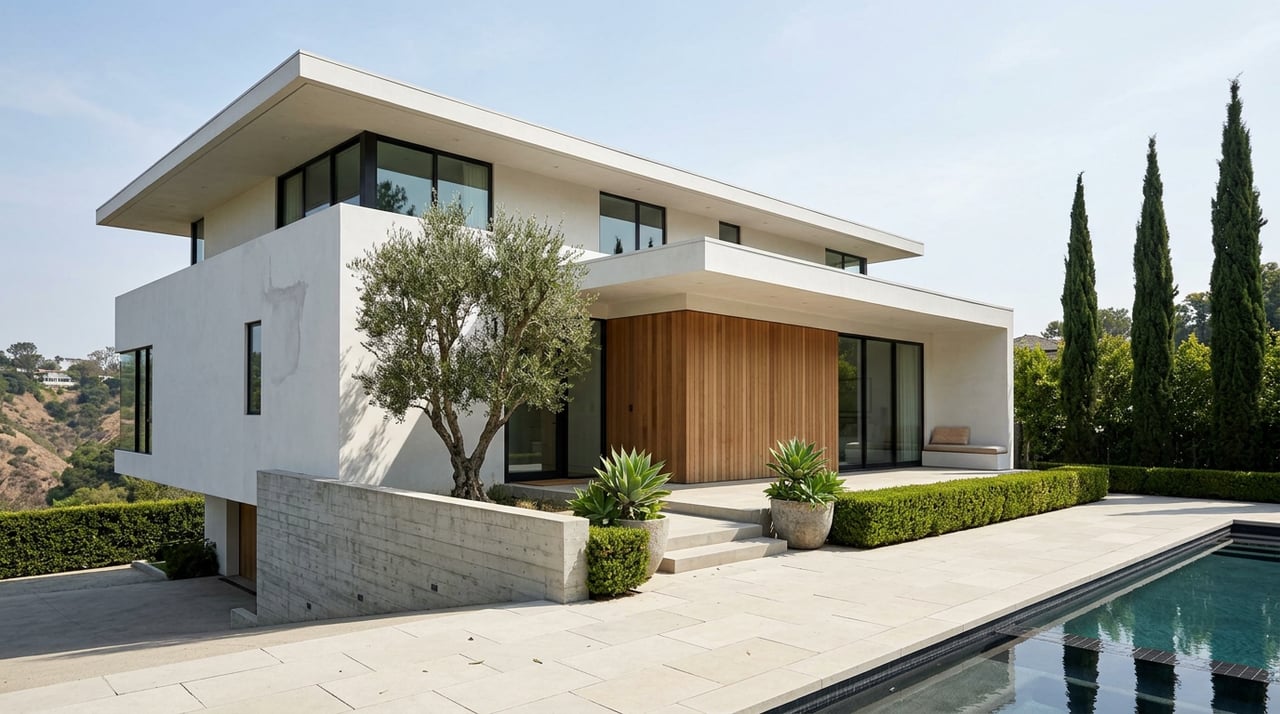
South of Ventura Boulevard, the land climbs into the Santa Monica Mountains, and the housing stock changes with it. Gated communities like Westchester Country Estates, built in the 1980s on lots that run from 3,000 to 16,000 square feet with a mix of Tudor, Mediterranean, and Spanish Villa architecture, sit alongside Winnetka Estates and Natoma Estates on parcels of 12,000 to 25,000 square feet or more, many with canyon views. Hillside view properties in this part of Woodland Hills consistently command a meaningfully higher price per square foot than the flatland ranch homes a few blocks north, a gap driven by lot scarcity, elevation, and the buyers willing to pay for it.
So when someone tells you Woodland Hills is a $1.2 million neighborhood, the honest answer is that it's at least two neighborhoods wearing one ZIP code, and the street that separates them tells you more than the median does.
The second boundary is less visible on a map but more consequential in escrow. Step west across the city line into Calabasas and home values jump anywhere from 40 to 300 percent depending on the pocket, according to Zillow's Home Value Index tracking of the two areas. Step north into West Hills or Canoga Park and values drop by roughly a third. Woodland Hills sits at that hinge, which is a large part of why it has held roughly flat while markets on either side of it have swung harder in both directions.
The reason the Calabasas side commands that premium isn't just curb appeal. Calabasas and neighboring Hidden Hills are separately incorporated cities. Woodland Hills is inside the City of Los Angeles. That distinction is worth keeping in view when comparing homes on either side of the city line.
For transactions closing after June 30, 2026, Measure ULA charges 4 percent on the entire gross sale price of any Los Angeles property selling between $5.4 million and $10.9 million, and 5.5 percent on anything at or above $10.9 million. The seller pays it, it's collected through escrow, and it applies to the full sale price rather than just the amount over the threshold, according to the LA Office of Finance's own guidance on the tax. That gross-receipts structure is what makes it bite. A property that sells for $5.3 million owes nothing extra. The same property at $5.5 million owes 4 percent of the whole $5.5 million, not just the $100,000 over the line.
| Gross Sale Price | ULA Rate | Approximate Tax |
|---|---|---|
| Under $5,400,000 | None | $0 |
| $5,400,000 to $10,899,999 | 4% | $6M sale: about $240,000 |
| $10,900,000 and above | 5.5% | $12M sale: about $660,000 |
Now place that against the geography. A hillside estate in Westchester Country Estates that clears $5.4 million carries that tax exposure because it sits inside LA city limits. A comparable estate a few hundred yards west, once you've crossed into Calabasas, sits across the city line. That location is worth keeping in mind when comparing two otherwise similar homes.
If you're comparing Woodland Hills to Calabasas on price alone, the entry-level gap is real. Redfin's March 2026 snapshot put the Woodland Hills median sale price at $1,187,500 against $1,625,000 in Calabasas, a gap of roughly $437,500. For a starter or move-up buyer well under the ULA thresholds, that gap is the whole story, and Woodland Hills is the more flexible, lower-cost entry point.
But that math changes at the top of the market. Once you're pricing a hillside property south of Ventura Boulevard in the $5 million-plus range, the relevant comparison isn't the neighborhood median anymore. It's where your specific parcel sits in relation to the LA city line, alongside the other details that shape its value. Two boundaries, one about grade and one about incorporation, are doing more to set your actual number than anything happening at the old Promenade site.
Does selling in Woodland Hills and buying in Calabasas let me avoid Measure ULA? No. ULA applies at the point of sale for property inside the City of Los Angeles, regardless of where you buy next. It's a transfer tax on the transaction, not a status tied to your future address.
Will Rams Village raise property values nearby? Nobody can say that with confidence yet, because the project is still an unentitled proposal. There isn't a citable study of what a comparable project did to values elsewhere in Los Angeles, and the broader research on sports facilities and nearby home values is genuinely mixed.
What's actually being built in Warner Center right now, if not the stadium district? Affordable housing. The Alcove's second phase, Nova, is under construction with a spring 2028 target, and separate affordable projects from Elysian Housing and Capstone Equities and from Wellpointe are moving through the entitlement and construction pipeline under the Warner Center 2035 Plan.
Is Woodland Hills really one market? Treat it as at least two: the flatlands north of Ventura Boulevard, priced closer to $542 per square foot as of mid-2026, and the hillside estates south of it, which trade at a meaningfully higher rate per square foot on larger, view-oriented lots. Warner Center condos are a third category entirely, priced and financed differently from either.
If you're trying to figure out which side of either boundary your target property sits on, and what that means for your actual closing numbers, that's a conversation worth having before you write an offer or set a list price. Sally Greene works across Woodland Hills, Calabasas-adjacent pockets, and the wider West Valley, and can walk through the comps and the tax exposure that apply to your specific address. Let's Connect.
This article is general information, not legal, tax or financial advice. Consult a qualified professional about your situation.
Stay up to date on the latest real estate trends.
Connect with a real estate professional who values trust, insight, and personal attention. Every step is guided by a deep understanding of what “home” truly means.